
UNESCO and I: Stories and Perspectives – Mr. Kiichi Oyasu
As part of the ‘UNESCO WEEK 2024/25,’ we interviewed Mr. Kiichi Oyasu, a former UNESCO staff member, on the theme ‘UNESCO and I: Stories and Perspectives.’ Mr. Oyasu is currently working as the Director of the Education Cooperation Department of the Asia-Pacific Cultural Centre for UNESCO, and is a member of the UNESCO Future Co-creation Platform Secretariat.
Q: First of all, could you tell us about your background and about your job when you were at UNESCO?
I studied law originally. I wasn’t particularly interested in international cooperation and didn’t study English hard. The first time I connected with people overseas was in my student days, when a senior teammate in my university football team introduced me to an American international student, and we lived in a shared house together. That is when I accepted that ‘English is just a communication tool.’ So, I prioritized ‘what to talk about’ and ‘what to do’ and acquired English skills as a tool to perform them.
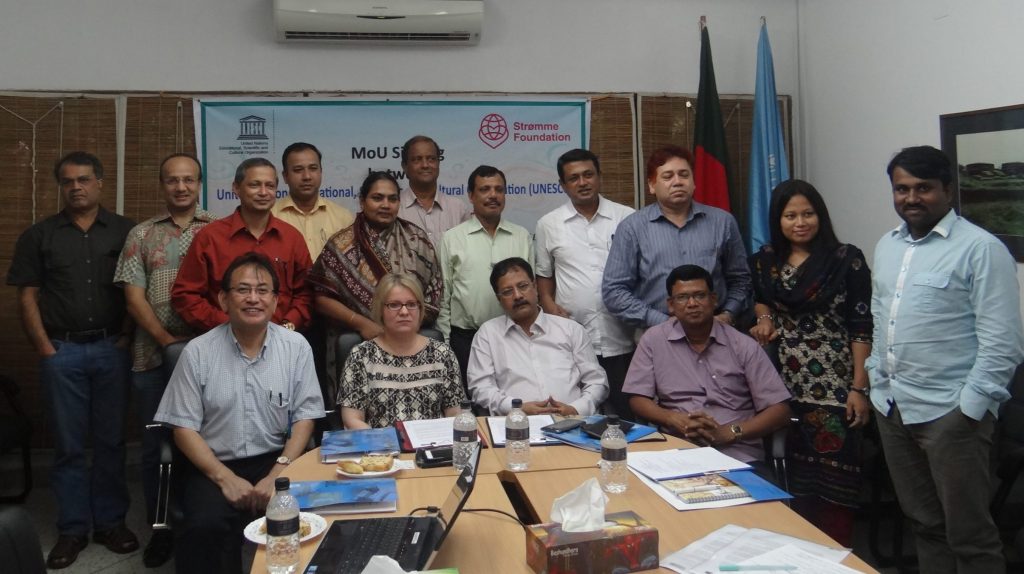
After I graduated, I worked as a civil servant at an affiliated organization of the Ministry of Education, and after that, I worked as a staff at UNESCO Regional Office in Bangkok. There, I was in charge of work related to community development through education and the Community Learning Centre (CLC) with themes like ‘Education for All’ and ‘Education for Sustainable Development (ESD).’ The Regional Office in Bangkok, where I worked for over a decade, was responsible for the Asia-Pacific region. And I was engaged in work such as training, teaching-learning materials development, and intergovernmental meetings, utilizing the networks of member states. Then, I worked for about 7 years at the Dhaka Office in Bangladesh, and was engaged in a wide variety of tasks, from direct collaboration with the Ministry of Education and related organizations, and from policy-making to local-level activities. It was a very interesting experience, since there were various activities of UNESCO as an international organization.
Also, I was able to further explore my research topic by connecting with Japanese and overseas researchers and by actively participating in academic conferences during my time at UNESCO. In my doctoral dissertation, I analysed community participation and public services through CLCs in Japan, Thailand, and Bangladesh.
Q: Were there any challenges or difficulties you experienced as a staff member of UNESCO? Also, what did you find rewarding? If you have any stories, please share them.
The job of UNESCO is mainly to define the international framework and direction. Although UNESCO has limited funds and staff resources compared to UNICEF and the United Nations Development Programme, there are many staff with expertise, so we were able to move discussions forward with a long-term view. Since the Regional Office in Bangkok provided services to 47 countries in the Asia-Pacific region, I was able to hear stories from many countries and build networks, which was an extremely interesting experience. On the other hand, I felt a ‘sense of distance’ about how much the things discussed at the policy level are actually put into practice at the school or community level. For that reason, I continued to work hard to fill the gap between practice and discussion while conducting on-site visits and establishing good relationships with government and NGO officials. Luckily, when I was working there, a trust fund from Japan was ample, and we were able to actively promote CLCs in the Asia-Pacific region. I recently heard that in Bangladesh, community people have taken ownership of small-scale projects, and the projects are sustained by local funding even after completion. Also, in recent years, the collaborations between Japan’s Kominkan and CLCs of Asia and Africa are progressing. I am very happy that the work I was engaged in during my time at UNESCO are still connected to the present.
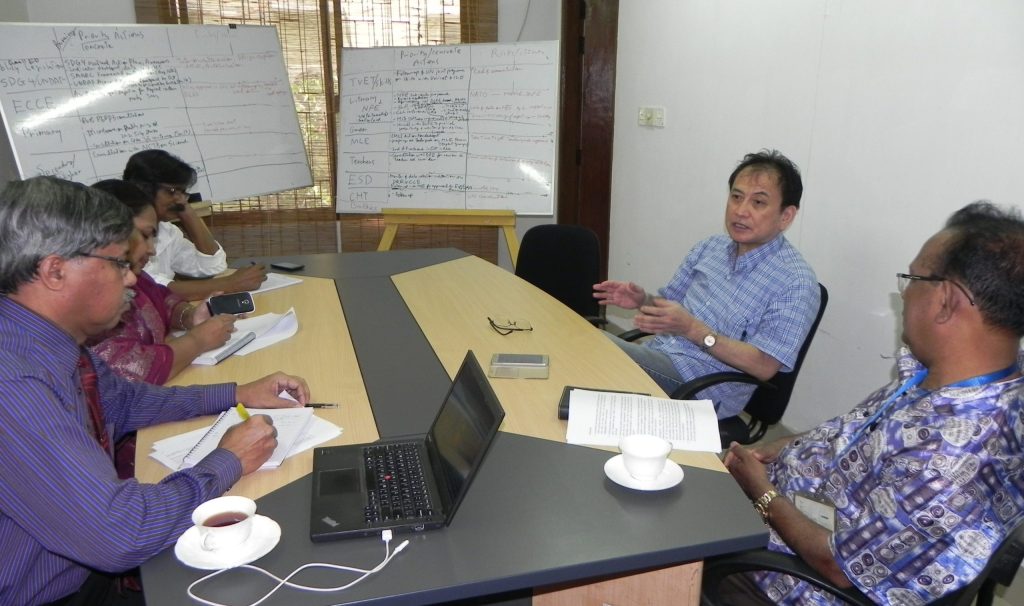
Q: Currently, you are still involved in domestic and international UNESCO-related projects as the Director of the Education Cooperation Department of ACCU. Do you have any new perspectives on UNESCO since observing from the outside? And how do you think your experience at UNESCO is serving you now?
Upon returning to Japan, I first took a job at a university, and it had nothing to do with UNESCO. But since I started working at ACCU, I’ve been surprised that UNESCO-related activities are so popular in Japan. Because UNESCO covers a very wide range of fields including education, science, culture, and information, discussions tend to be abstract. Even so, it is important to set directions such as ‘Education for All,’ ‘ESD,’ and ‘Inclusion.’ I hope we will be able to better synergize the resources of member states that agree with these principles.
From my experience at UNESCO, I learned that there are various people and various ways of thinking and doing in the world. Although I understood logically that ‘my common sense’ does not always apply everywhere, I fully realized the difficulty through actual collaboration and communication. I also felt that, when working with people with diverse abilities, it is especially important to move forward by doing what we can while filling in the gaps, rather than pursue perfection.
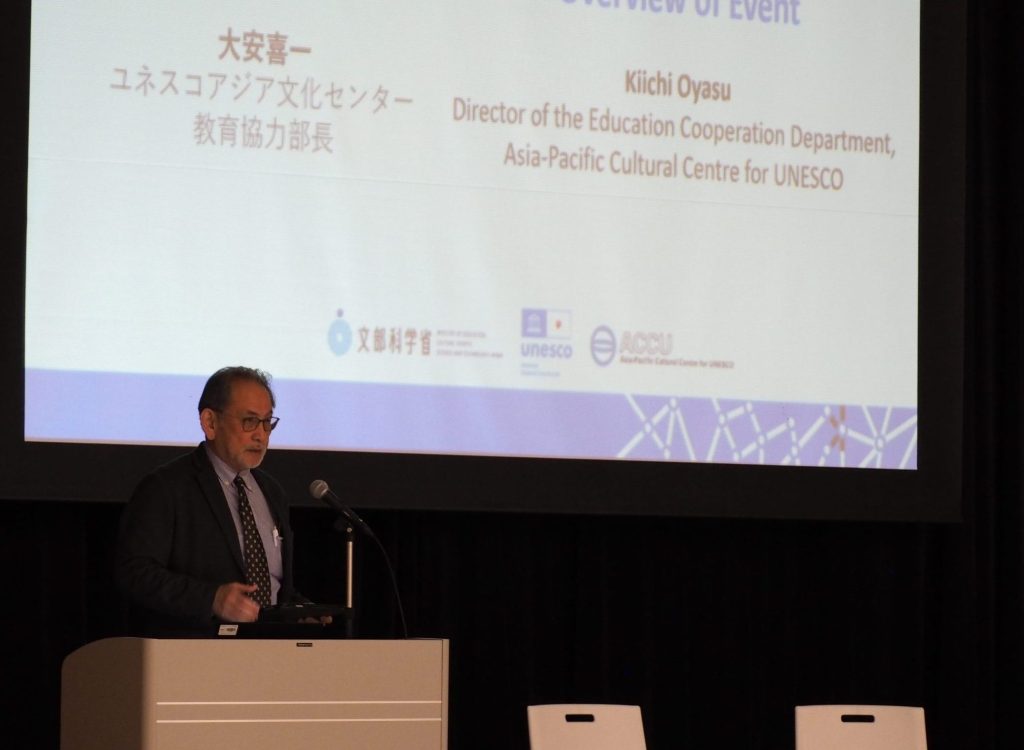
At the opening ceremony of an event hosted by the UNESCO Future Co-creation Platform Secretariat
Q: Do you have any advice to people who wish to work in international organizations such as UNESCO?
As I mentioned at the beginning, I wasn’t interested in international relations at first. Regarding languages and different cultures, I believe one can understand their necessity not only through theory but also through practice and experience. The knowledge we acquire from literature and lectures is valuable, but connecting with people overseas without fear of failure and experiencing situations where we are a minority are also important. Although AI has developed, as of now, English is used in most situations when communicating with people overseas. Willingness to learn through trial and error is important, and I would encourage, in particular, youths to take on the challenge if they get an opportunity to study abroad, do an internship, or work at an overseas institution. Also, it is important to start with what is close to home, in a variety of fields such as education, culture, and science. By addressing the situation and challenges in Japan, and at the same time, considering them from a global perspective, I believe a new approach that goes beyond simple international development aid will be created.
Q: This is the last question. The key phrase of the UNESCO WEEK 2024/25 is ‘creating a sustainable and inclusive future.’ How would you describe the future you envision from ‘creating a sustainable and inclusive future?’ And please give a message to our readers.
Creating the future is the responsibility of all generations. To build a sustainable and inclusive society, it is necessary to think about newly emerging challenges from multiple perspectives and act cooperatively. It is important for diverse people to try diverse approaches and keep learning, while respecting each other. We need not only formal education backgrounds but also the perspective of ‘lifelong learning,’ to keep learning and stay alert even after becoming an adult, a member of society, or after retiring. To do that, we also need the ability to utilise diverse information sources and learning opportunities, what’s called ‘digital literacy.’ I believe that to strive for a society that is sustainable and inclusive, it is important to not stick to one way of doing things, but accept various methods, and move forward by trial and error.
DATA
Interview conducted in November 2024 |
|
*This is an English translation of an article that was originally written and published in Japanese on 26 November 2024 (https://unesco-sdgs.mext.go.jp/column/unesco-story-20241126). |