
Youth Looking Ahead to Embody UNESCO’s Ideal: Participating in The Third International UNESCO Model “Ethics of the Use of Artificial Intelligence in Education”
I participated as the Japanese representative in the Third International UNESCO Model “Ethics of the Use of Artificial Intelligence in Education”, held in Almaty, Kazakhstan.
This programme is an educational event where participants play the role of representatives of UNESCO Member-States, simulating meetings that take place within the organisation. It was organised by UNESCO, the National Commission of the Republic of Kazakhstan for UNESCO, the UNESCO Club of Kazakhstan, the Islamic World Educational, Scientific and Cultural Organisation (ICESCO), and the UNESCO Office in Almaty.
The theme of the event was the ethics of utilising AI in educational settings. Please refer to the article below for the background to this theme:
Artificial Intelligence (AI) holds promise in tackling significant education challenges, revolutionizing teaching and learning methods, and advancing progress toward SDG 4. Nevertheless, the rapid advancement of technology presents various challenges and risks, surpassing the ongoing policy discussions and regulatory structures. UNESCO is dedicated to aiding Member States in leveraging AI’s potential for realizing the Education 2030 Agenda, while ensuring its application in education adheres to principles of inclusivity and fairness. (Quoted from UNESCO: The Third International UNESCO Model on AI Has Been Launched Associations and Clubs for UNESCO Movement.
https://www.unesco.org/en/articles/third-international-unesco-model-ai-has-been-launched-associations-and-clubs-unesco-movement)
Based on UNESCO’s human-centred approach to AI, we discussed how AI should be introduced into educational settings. The three-day online training and an on-site model UNESCO conference held from 12-14 August proved highly instructive.
First, during the online training, there were preparatory lectures on topics such as guidelines for AI use in education, the integration of AI into culture and its challenges, and media/information literacy. Following that, in Kazakhstan, we took part in group work and the model UNESCO sessions.
During the groupwork, participants were divided by region to discuss such topics as the global challenges considered important in their respective areas, how to address them, and how to collaborate with other regions. My group represented the Asia-Pacific region with members from Australia, Malaysia, the Philippines, (Hong Kong), Kazakhstan and Turkmenistan. The main topics discussed in this group were social inclusion and AI development. For the culturally diverse nations of the Asia-Pacific region, achieving the inclusion and integration of cultural diversity was an important challenge. In addition, it became clear that the perceived challenges differed significantly among the countries, while Japan and China (Hong Kong) had challenges because of technological advancement, nations such as Malaysia and the Philippines faced issues with access to digital devices. For instance, in the former countries, while the introduction of AI and certain regulations has begun, the pace of technological advancement is so rapid that appropriate regulations and rules have yet to keep up. On the other hand, according to the participants from the latter countries, many of which are facing economic development challenges, a strong sense of attachment to traditional educational methods and lifestyles makes it difficult to establish the foundation for AI adoption.
How to address these significantly different challenges seemed to be a unique issue for the highly diverse Asia-Pacific region.
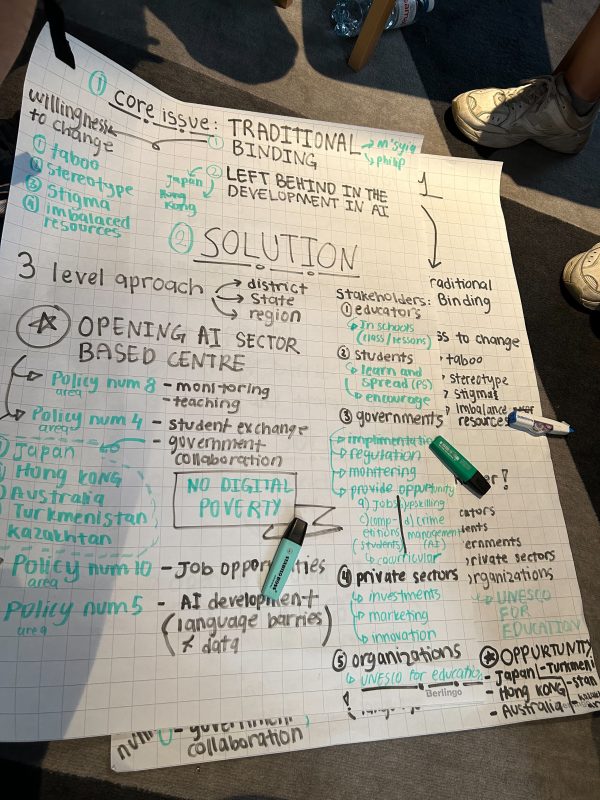
Subsequently, we held mock UNESCO sessions at the UN Plaza. In the first session, each participant shared, within approximately two minutes, our country’s use of AI in education, related challenges, and priorities. Here, I explained Japan’s current AI utilisation and regulatory landscape, specifically the concept of human-centred AI, AI strategies related to it and privacy protection regulations. While this session further highlighted differences in the challenges and level of AI adoption across countries, it also demonstrated that there were common global issues. For example, it appeared that the shortage of teachers capable of using AI effectively and safely was a shared challenge across the countries.
During the subsequent second session, we were divided into three groups and presented our prepared strategic proposals, each in three-minute presentations. From a global perspective, my proposal called for holding regular roundtable meetings involving diverse stakeholders, particularly educational institutions and companies. I also suggested awarding a special certification label to organisations that have participated in the roundtable meetings for a certain period, to encourage active and continuous corporate participation. Other participants made diverse proposals, including creating an international organisation specialising in AI, formulating five-year plans for the AI strategies of one’s own country, teacher training programmes and developing apps for use in educational practices.
This event was also an invaluable opportunity to meet other participants and young people from many different countries. There I gained a tangible sense of how Japan is perceived as a partner by Central Asian nations. Participants from every country showed keen interest in Japan’s AI policies, and in many instances, I felt that there was significant room for Japan, as a major financial contributor to UNESCO, to cooperate with those countries. Having said that, I also found it regrettable that Japan’s contributions to UNESCO in this field often seemed to be largely unknown domestically. For example, most of the videos recommended for viewing during the preparatory session and during the pre-conference training were produced with Japanese cooperation, yet few Japanese people seem to be aware of them.
Featuring AI within the context of education, a theme close to young people’s lives, led to a lively discussion. What struck me was how frequently the potential of AI was touched upon during the discussion, in the context of topics such as teacher training and roadmap development. This focus on potential, rather than solely on risks or what to stop or halt, seemed to me a strength of youth.
This opportunity to engage directly with young people from many nations has made me confident that we will be able to continue to maintain close relationships in the future. I believe that the future-oriented approach of the young people, embodying UNESCO’s principle of “it is in the minds of men that the defences of peace must be constructed”, will bear more fruit in the future. As a member of Youth Committee of the Japanese National Commission for UNESCO, I will work to ensure that the committee will be part of that process.

At the UN Plaza in Almaty (formerly the UN Almaty Office)
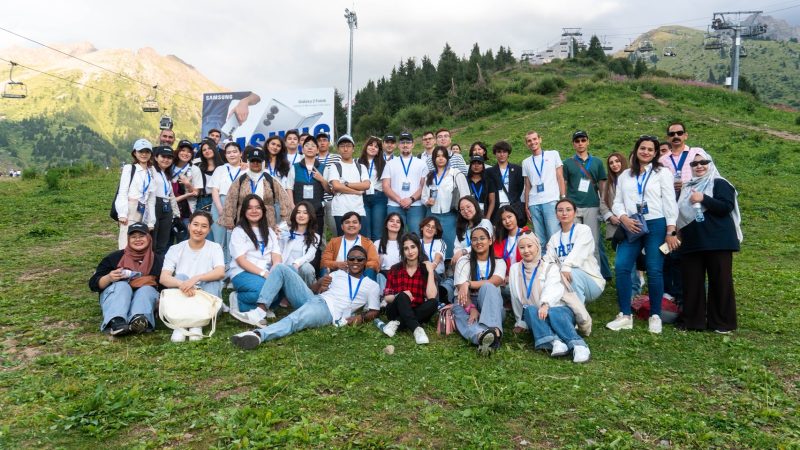
At the cultural programme held at the Shymbulak Ski Resort
DATA
| Event | The Third International UNESCO Model “Ethics of the Use of Artificial Intelligence in Education” |
|---|---|
| Date | 12–14 August 2024 |
| Place | Kazakhstan |
| Report by | Wakana Azuma (Youth Committee of the Japanese National Commission for UNESCO, as of August 2024) |
*This is an English translation of an article that was originally written and published in Japanese on 16 May 2025 (https://unesco-sdgs.mext.go.jp/column/youthnote-20250516). |