Let’s Start from Here! Youth Forum Featured Cross-Generational Chemistry
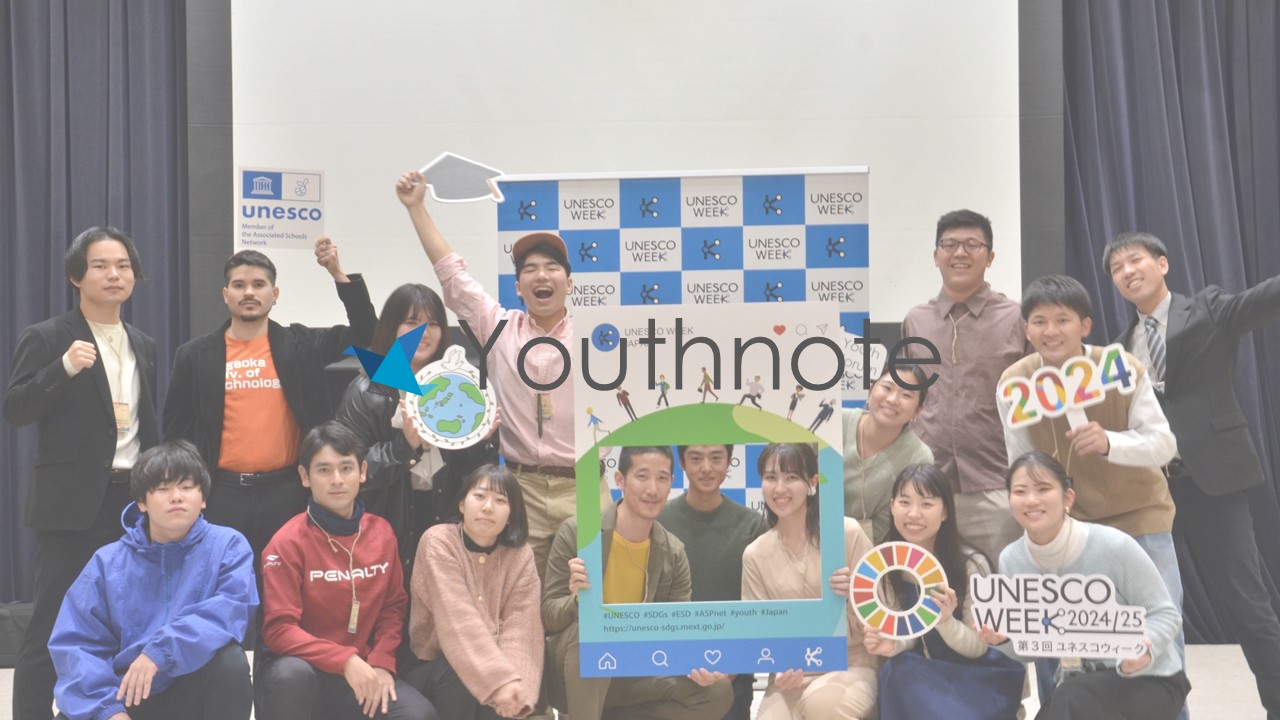
The Youth Forum of the UNESCO Week 2024/25, led by the Youth Committee of the Japanese National Commission for UNESCO, was held on Sunday, 1 December 2024 in a hybrid format (in-person at the Youth Education National Olympics Memorial Youth Centre and online). The Youth Forum is organised annually by the Youth Committee of the Japanese National Commission for UNESCO as a platform to expand connections among youth nationwide, as well as to highlight their activities throughout the year.
This year’s theme was “From Now, From Here, From Me: Youth Power Creating the Future of UNESCO-Related Activities”. The programme of the forum was designed to have participants consider the present and future of youth activities and how to engage in UNESCO-related activities in their own way.
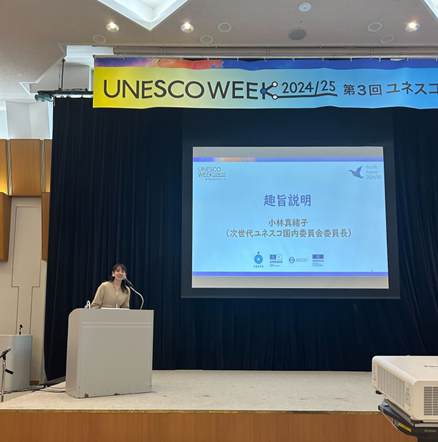
This second iteration, following last year’s, saw participation from numerous young people, resulting in a highly energetic and vibrant forum. In her speech “Statement of Purpose” at the opening, Maoko Kobayashi, Chairperson of the Youth Committee of the Japanese National Commission for UNESCO, emphasised the challenging nature of building both vertical and horizontal connections, expressing the organisers’ commitment to the creation of diverse connections through this event.
The subsequent section featured a video message from film director Naomi Kawase, who is also a UNESCO Goodwill Ambassador. She made two points in the video that particularly impressed the participants. The first was that there are things that only youth can express, and by presenting them to adults aiming to make them a reality, we should foster coexistence and symbiosis across generations. The second was that even with the conviction that when a friend takes a different path from you to pursue their dream, you should feel confident that it is not a farewell because you will be able to work together again someday, and that confidence will be the core of your innermost self. For me, this insight changed my mindset regarding youth turnover as something negative.
A positive atmosphere filled the room after the participants received Ms Kawase’s subtle yet powerful messages; it was as if I could hear their inner voice of determination, “Yes! We can do it!”.
Ms Kawase’s video message will be available for viewing later (click here for YouTube video in Japanese).

Subsequently, with Ms Rika Sueyoshi, representative director of the Ethical Association as moderator, a panel discussion took place on the theme “The Future of UNESCO-Related Activities Led by Youth”, featuring panellists from both the youth and senior generations. The panellists were Mammadova Aida, associate professor at Kanazawa University, Hotaru Nagano, Japanese representative for the UNESCO Global Geoparks Youth Forum, and I also joined the panel representing the Youth Committee of the Japanese National Commission for UNESCO.
The discussion proceeded with the senior generation responding to challenges currently faced by youth. In response to such youth concerns as “People who were involved in local activities as high school and university students are drifting away from them”, and “How can youth, with their high turnover, ensure continuity in these activities?”, one of the senior panellists shared the following insights: “Japan still lacks activities rooted in real-life experience and integrated into one’s own lifestyle. What kind of way of life do you value, and what activities do you undertake to support that? What are the lifestyles of those working in the field, such as in geoparks and UNESCO Biosphere Reserves ? What issues do they feel strongly about? Accumulating real experiences that enable you to answer those questions and connecting them to your own activities is the key to continuity”.
“We would love to cooperate with you. Let’s work together by all means”.
“As a youth member, I have plenty of ideas, energy, and passion. I want to make them materialise. All the youth gathered here today, let’s make it happen. Senior generations, please listen to our voices”.
After youth and the older generations exchanged such messages, the panel discussion came to an end.
One key focus of this year’s Youth Forum was networking. Youth organisations from across the nation displayed posters and exchanged views with participants during the lunch break.
 |
|
The afternoon programme was organised into three breakout sessions.

Session A [Education] “Shaping the Future of Learning Together – Using UNESCO Recommendation as a Starting Point”
Session B [Disaster Prevention] “Learning and Practising Disaster Prevention from a UNESCO Perspective – Disaster Prevention for the Future”
Session C [Community Development] “Thinking Together About the Future of “My City”: With the UNESCO Creative Cities Network as an Example”
The breakout sessions were created through collaboration between the respective working groups (Education, Science, Culture) organised within the Youth Committee of the Japanese National Commission for UNESCO and other youth organisations, and it also served as a platform for leveraging the connections built up during the preparation process. I hope that the Youth Committee of the Japanese National Commission for UNESCO will continue expanding the scope of its activities, functioning as a hub connecting different youth organisations to create a major youth movement.
Following the sessions, a general workshop titled “My UNESCO Story Map — Reflect on Past UNESCO-Related Activities and Get Inspired for Continuation and Development!” was held, focusing on the future careers of the youth.
This session was open only to youth, and those who attended the Youth Forum used a worksheet titled “My UNESCO Story Map” (available on pages 6–7 of the programme in Japanese) to reflect on their past activities. By answering such questions as “What prompted you to start your activities?”, “What was challenging for your activities?”, and “What was rewarding?”, the participants were able to review their activities carefully, thereby reaffirming their original enthusiasm. Personally, this session made me reflect on my junior high school years when I first became interested in education. By tracing my own path, I was able to solidify my core values for continuing my UNESCO activities.
Subsequently, five working professionals who are employed by private companies or local governments while engaging in social contribution activities through their main work or pro bono work shared their career journeys from student activities to their current occupations. Following that, there was time for dialogue between the speakers and participants. This took place in groups, with the speakers rotating between several groups. The youth participants asked such questions as “How does your current activity connect to your profession?” and “How can I find my future career direction?”, to which the speakers answered citing examples and lessons from their own diverse experiences.
After the dialogue time, the participants formed a large circle with the youth inside and the senior generation outside and performed the Talk Folk Dance. During this dance, the participants formed pairs with those opposite them, swapping partners to discuss such themes as “new challenges they wish to undertake” and “resolutions to make after this Youth Forum”. The atmosphere was friendly throughout, and the event succeeded in facilitating intergenerational interaction.
Comments from Speakers at Each Session
—Thoughts on Speaking at the Youth Forum and Messages to Youth—
Session A [Education]
Professor Yoshiyuki Nagata (University of the Sacred Heart, Tokyo; Chairman of Japan Association for International Education)
The Youth Forum gave me plenty of hope. While the UN has recently prioritised youth-focused policies, Japan has been said to face difficulties in implementing them. However, in this forum, I could see signs of youth-led initiatives emerging, leading to a sustainable future. I look forward to seeing you take on greater roles as leaders, rather than being one among many stakeholders!
Session B [Disaster Prevention]
Mr Yoshihiro Kakizaki (Geologist, Muroto UNESCO Global Geopark)
This was my first time participating in the Youth Forum. I was struck by the high level of awareness among the young people attending the forum in their respective fields. On the other hand, I also heard that one of the problems was the loss of connections when youth become working adults. Therefore, I would very much like to invite all the youth to join the Geoparks Network. Geoparks, which connect people from diverse backgrounds, will undoubtedly contribute to building youth networks.
Session C [Community Development]
Ms Ayako Suzuki (Yamagata International Documentary Film Festival)
Thank you for inviting the youth of Docu-Yama (Yamagata International Documentary Film Festival) to speak at this session. For the two high school students who participated this time, making a presentation before senior members of the youth generation was, I believe, a meaningful and highly educational experience. The session also provided a valuable opportunity to broaden the scope of Docu-Yama Youth’s activities. I am also very pleased that quite a few young people from Yamagata Prefecture are active in the Youth Committee of the Japanese National Commission for UNESCO, including Pati Nagasawa, a Docu-Yama Youth alumna who connected us to the Youth Forum. I will keep cheering you on from Yamagata, so that your activities will continue for a long, long time.
The Youth Forum started with a wish to strengthen vertical and horizontal connections among youth. It has evolved into a forum that involves youth from various backgrounds: UNESCO-related activities stakeholders, and even companies, reflect on past activities, think together about the present and plan the future. Across the country, there are young people engaging in a variety of activities, as well as NPOs/NGOs with diverse knowledge and many experienced people from senior generations, all of whom have already been involved in many proactive initiatives. Creating spaces to connect them and foster their collaboration while expanding the range of activities—this remains the mission of the Youth Committee of the Japanese National Commission for UNESCO, and for me, this forum was an opportunity to reaffirm my commitment to working toward that mission. I sincerely hope that readers of Youthnote will continue to take on the challenges together with the Youth Committee of the Japanese National Commission for UNESCO.
Once again, I extend my sincere gratitude to all those involved in organising the Youth Forum, to the youth members nationwide who helped shape the subcommittee sessions, to the speakers who participated, and to everyone who attended on the day.
DATA
| Event | Youth Forum of the 3rd UNESCO Week 2024/25 |
|---|---|
| Date | Sunday, 1 December 2024 |
| Place | Youth Education National Olympics Memorial Youth Centre |
| Organiser | Ministry of Education, Culture, Sports, Science and Technology (MEXT)/Japanese National Commission for UNESCO/ |
| Co-organiser | United Nations Educational, Scientific and Cultural Organisation (UNESCO) |
| Sponsor | Ishizaka Inc. |
| Report by | Wakana Azuma (Youth Committee of the Japanese National Commission for UNESCO, as of December 2024) |
*This is an English translation of an article that was originally written and published in Japanese on 30 May 2025 (https://unesco-sdgs.mext.go.jp/column/youthnote-20250530). |